
For builders and site managers
Builder & Site Hydroseeding in Orlando, FL
Large-area seed and mulch that gets disturbed ground stabilized and permits closed.
- No-charge walk-through of the lot before we quote
- Seed matched to Florida warm-season grasses, not northern blends
- Seed, mulch, prep and erosion items listed on separate quote lines
Getting Disturbed Ground Covered and Closed Out
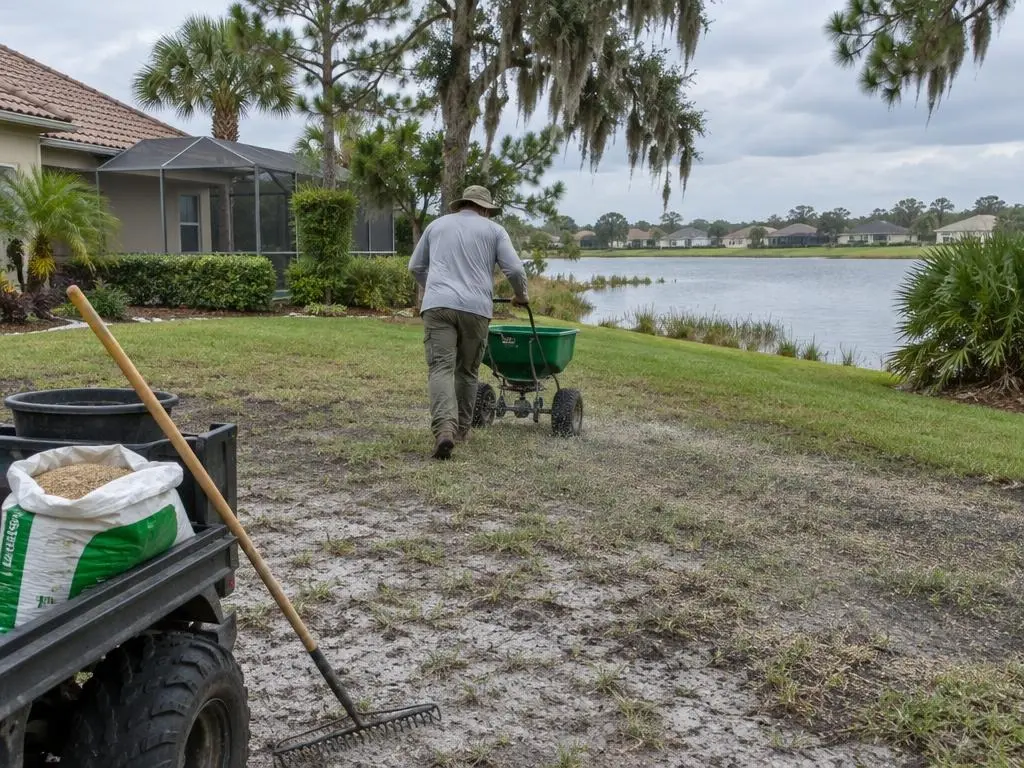
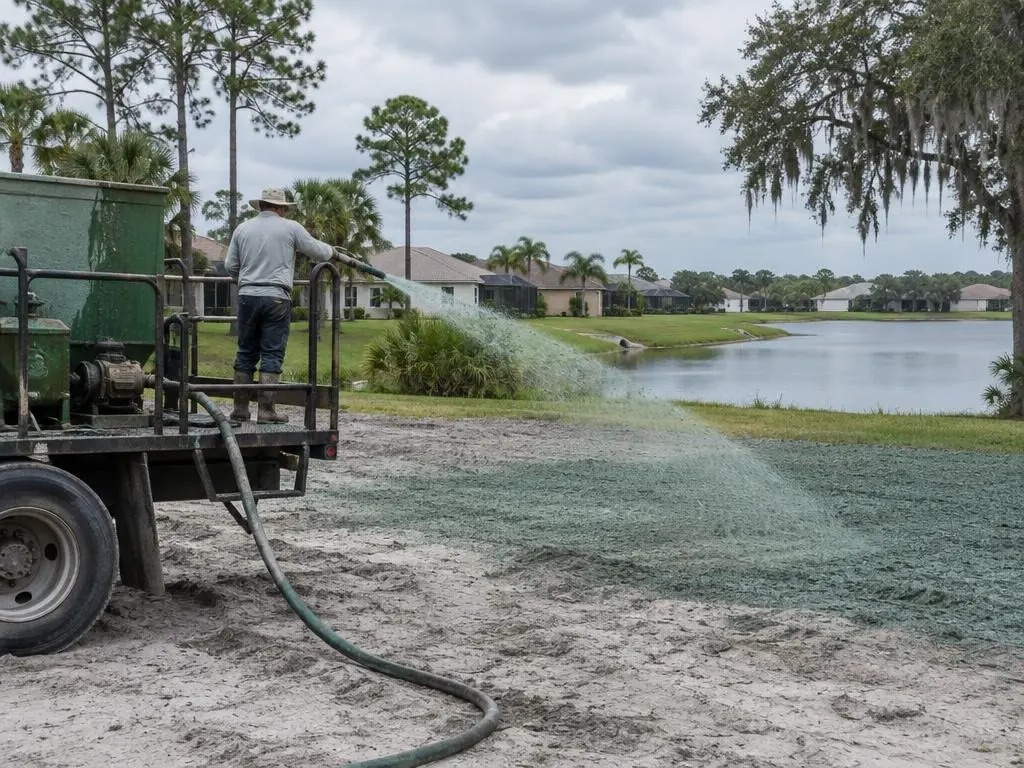
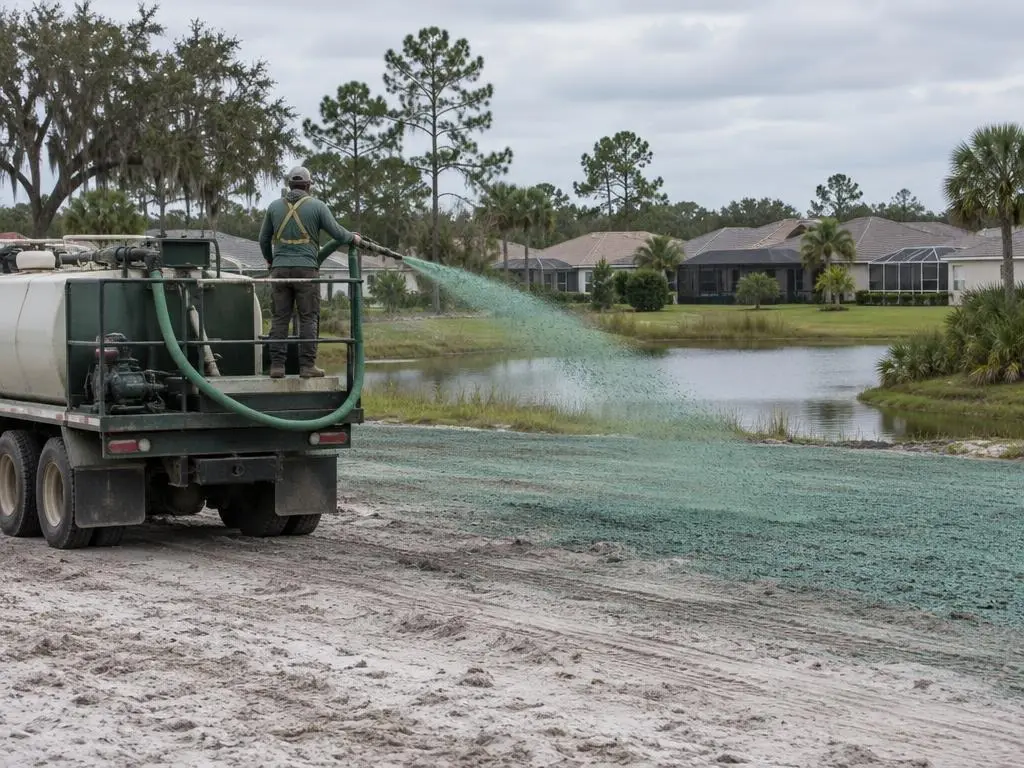
Builder and site hydroseeding in Orlando is about one thing for most of our commercial customers: getting disturbed soil covered so the site holds together in the next storm and the stormwater permit can be closed. We seed subdivision lots and common areas, commercial and industrial pads, road and utility corridors, retention pond banks, and the leftover strips around parking lots. As hydroseeding contractors we spray from a tank truck, so acres of ground can be covered in a day where hand seeding and straw would take a crew a week.
What the state permit expects
The Florida Department of Environmental Protection requires Construction Generic Permit coverage for projects disturbing at least one acre. A site under an acre still needs coverage if it belongs to "a larger common plan of development or sale" (the permit's own wording), provided it drains to surface waters or a municipal storm sewer. The permit requires a stormwater pollution prevention plan and practices that keep erosion and sediment on site. The operator files a Notice of Termination within 14 days after the site reaches final stabilization. In plain terms, vegetation on the disturbed ground is how many sites get from open permit to closed permit, and that is the work we do.
Water district and local inspections
Many projects in the region also carry an Environmental Resource Permit. The St. Johns River Water Management District, which has reviewed new development for both water quality and water quantity since 1986, sends compliance staff to inspect sites during construction to make sure stormwater is not washing debris into storm drains, wetlands or surface waters. Local governments add their own requirements, and in Orlando's checkerboard of city land and unincorporated Orange County, the right office is not always obvious. We work from your approved plans and ask who inspects before we schedule.
Seed for big, unirrigated areas
Most commercial ground will never see a sprinkler. That is why bahiagrass is the backbone of so much site seeding in Florida: UF/IFAS describes it as deep-rooted, persistent in infertile sandy soil, and low in water and fertilizer needs. Pensacola bahiagrass produces more seed heads, which makes it less desirable in a home lawn but suitable for roadside plantings. Where a quick temporary cover is needed in the cool season, we talk through the options with you, since cool-season grasses do not last in Florida's heat.
Working around the weather
Orlando's rainy season runs from May into late October, and summer storms can drop several inches of rain an hour. A freshly graded pad can lose its surface in one storm. We schedule spraying as close to final grading as we can, raise the fiber mulch rate in the wet months, and pair seeding with blankets or check structures in channels. In the dry season, from November through April, the challenge is moisture, so a water truck or temporary irrigation may be worth adding on high-visibility areas.
Scale and coordination
The Orlando metro had about 2.67 million people at the 2020 census and keeps building outward. Builders often need seeding in phases, lot by lot, as houses finish. We can return for each phase, seed punch-list areas after utilities and landscaping crews are done, and reseed thin spots before an inspection.
Bid sets and site plans are welcome. Get a free estimate
Sites We Seed
Common commercial and construction scopes.
Subdivision lots and common areas
Front and rear lots, tracts, berms and greenbelts seeded by phase.
Commercial and industrial pads
Unpaved areas around buildings, future pads and overflow ground stabilized.
Retention and detention ponds
Side slopes and tops of bank seeded and mulched, with blankets where water runs.
Road and utility corridors
Shoulders, ditches and pipeline or conduit restoration strips.
Punch-list and reseeding
Thin or washed areas re-sprayed before final inspection.
Temporary stabilization
Mulch-only or temporary cover on ground that will be disturbed again later.
Per-Acre Figures for Larger Seeding Jobs
| Scope | Published figure |
|---|---|
| Large-area hydroseeding per acre (LawnStarter) | $2,136 to $4,897 |
| Hydroseeding per acre (Fixr) | $2,000 to $4,000 |
| One acre, consumer range (HomeAdvisor) | $2,600 to $8,700 |
| Two bids received on a 2023 park seeding job, per acre (North Little Rock, Arkansas) | $2,595 and $3,325 |
Commercial pricing depends on acreage, access, water source, mulch rate and phasing. The total on the signed bid is what you pay.
How a Site Job Runs
1. Plan review
We read the stormwater plan, seed specs and phasing, and ask who inspects.
2. Site check
We confirm final grade, access for the truck and a water source.
3. Spray
Seed, fiber mulch, fertilizer and tackifier at the specified or season-adjusted rate.
4. Follow-up
We check germination and reseed thin or washed areas so the site reaches stabilization.
Why Choose Us for Builder & Site Hydroseeding
Truck-scale coverage
Large tank spraying covers acres in a day.
Phase-by-phase scheduling
We come back as each section of a subdivision is ready.
Close-out focus
The aim is the vegetation your permit needs for final stabilization.
Unirrigated seed choices
Seed picked to survive without sprinklers on sandy ground.
Builder & Site Hydroseeding Questions
What do hydroseeding companies charge per acre?
Fixr's consumer range is roughly $2,000 to $4,000 an acre and LawnStarter's is $2,136 to $4,897, and two bidders on a 2023 Arkansas city park job priced it at $2,595 and $3,325 an acre. Commercial bids depend heavily on access, water and mulch rate.
When can I file the Notice of Termination for my construction permit?
Under Florida DEP's Construction Generic Permit, the Notice of Termination is due within 14 calendar days after the site achieves final stabilization, or after discharges are covered by another permit. Your SWPPP defines what stabilization means for your site.
Can you seed in phases as homes are finished?
Yes. Many builders call us back lot by lot or section by section, and we reseed areas disturbed by late utility or landscape work.
What grass do you use on commercial ground with no irrigation?
Bahiagrass is the usual choice for unirrigated sandy sites because it roots deep and tolerates low fertility. If your plans specify a seed mix, we follow the specification.
Do you bring your own water?
We fill the tank from an approved source, such as a hydrant meter or a site connection where the project allows it. We sort that out during the site check.
Builder & Site Hydroseeding Service Areas
- Hydroseeding in Orlando, FL
- Hydroseeding in Winter Park, FL
- Hydroseeding in Apopka, FL
- Hydroseeding in Winter Garden, FL
- Hydroseeding in Ocoee, FL
- Hydroseeding in Windermere, FL
- Hydroseeding in Kissimmee, FL
- Hydroseeding in St. Cloud, FL
- Hydroseeding in Celebration, FL
- Hydroseeding in Davenport, FL
- Hydroseeding in Clermont, FL
- Hydroseeding in Minneola, FL
- Hydroseeding in Mount Dora, FL
- Hydroseeding in Horizon West, FL
- Hydroseeding in Lake Nona, FL
- Hydroseeding in Sanford, FL
- Hydroseeding in Lake Mary, FL
- Hydroseeding in Oviedo, FL
- Hydroseeding in Longwood, FL
- Hydroseeding in Altamonte Springs, FL
- Hydroseeding in Casselberry, FL
- Hydroseeding in Maitland, FL
- Hydroseeding in Groveland, FL
Get a Builder & Site Hydroseeding Estimate
Send plans or a site address and we will price the seeding.